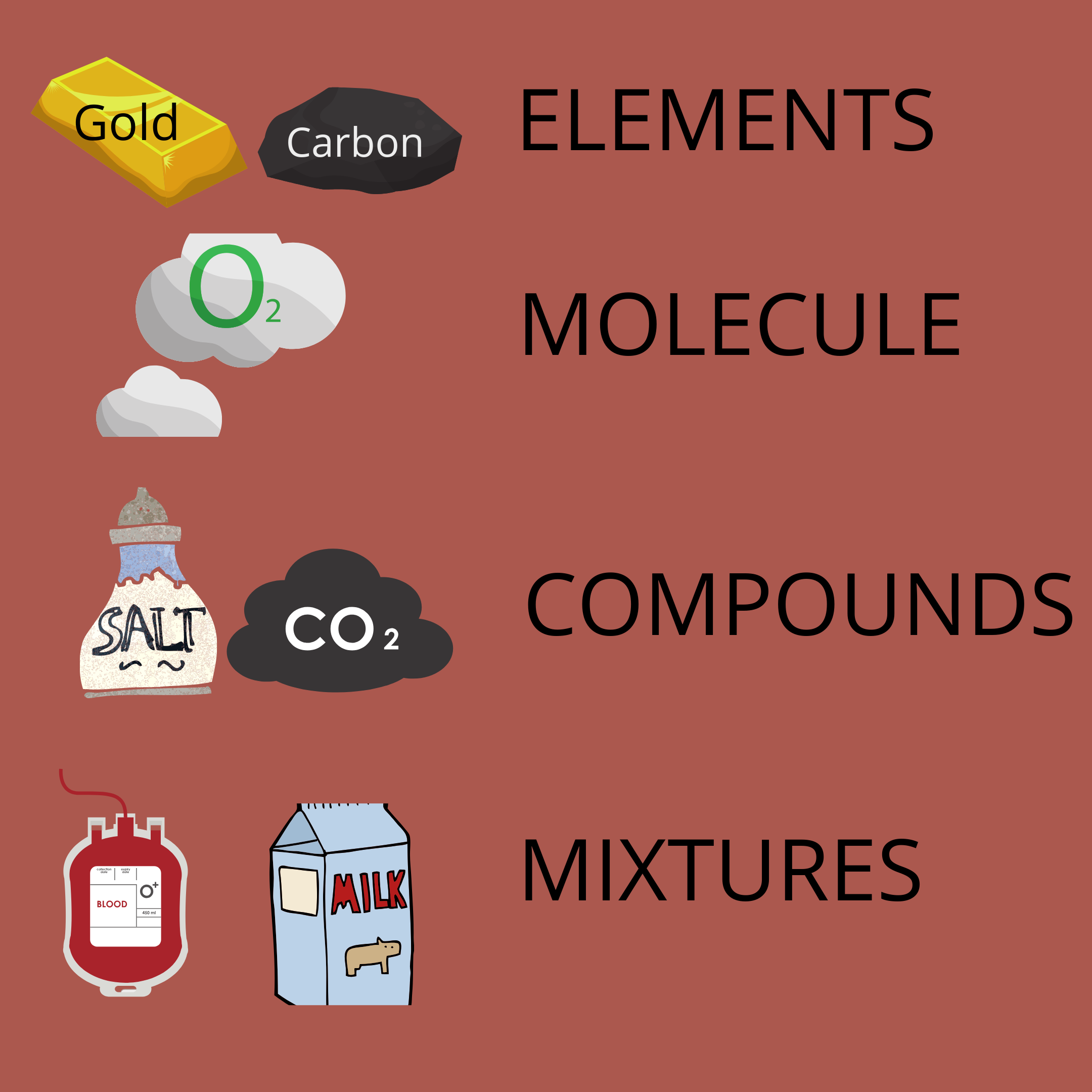
Elements are made up of only one kind of atoms with unique properties which are different from those of other atoms. Hence, it is considered the simplest form of matter and a pure substance. For example, oxygen, hydrogen, and carbon are all elements with a unique name. Atoms that oxygen is made up of are different from those of hydrogen or carbon. In nature, elements occur as either a population of individual atoms such as gold, carbon or as molecules of two or more atoms joined together.
A molecule is made up of two or more atoms which are chemically combined together. A molecule could be a combination of the same atoms (elements) or different atoms (compounds). For example, a molecule of oxygen is made up of two atoms of oxygen (O2) that are chemically combined together. However, a molecule of carbon IV oxide (CO2) is made up of an atom of carbon and two atoms of oxygen that are chemically bound together (an example of a compound).
A compound can, therefore, be defined as a form of matter composed of two or more different elements that are chemically bound together. The elements in a compound are in a fixed mass ratio. It is important to note that the properties of compounds are different from the properties of the component elements. For example, sodium is a soft silvery solid metal; when it combines with greenish-yellow gaseous chlorine, it forms crystalline white solid sodium chloride, commonly called table salt.
A mixture is a group of two or more substances (elements and/or compounds) that are physically combined together. Unlike in a compound, the components of a mixture can vary in their composition or mass ratio. Since the components are not chemically combined, they can be separated by physical process. In addition, a mixture retains some of the properties of the component substances. For example, when sodium chloride (table salt) is mixed with another compound, water, the solution that results is, a mixture that retains the colour and physical state of the chloride.
 HTB ReStyle
Leave a comment